
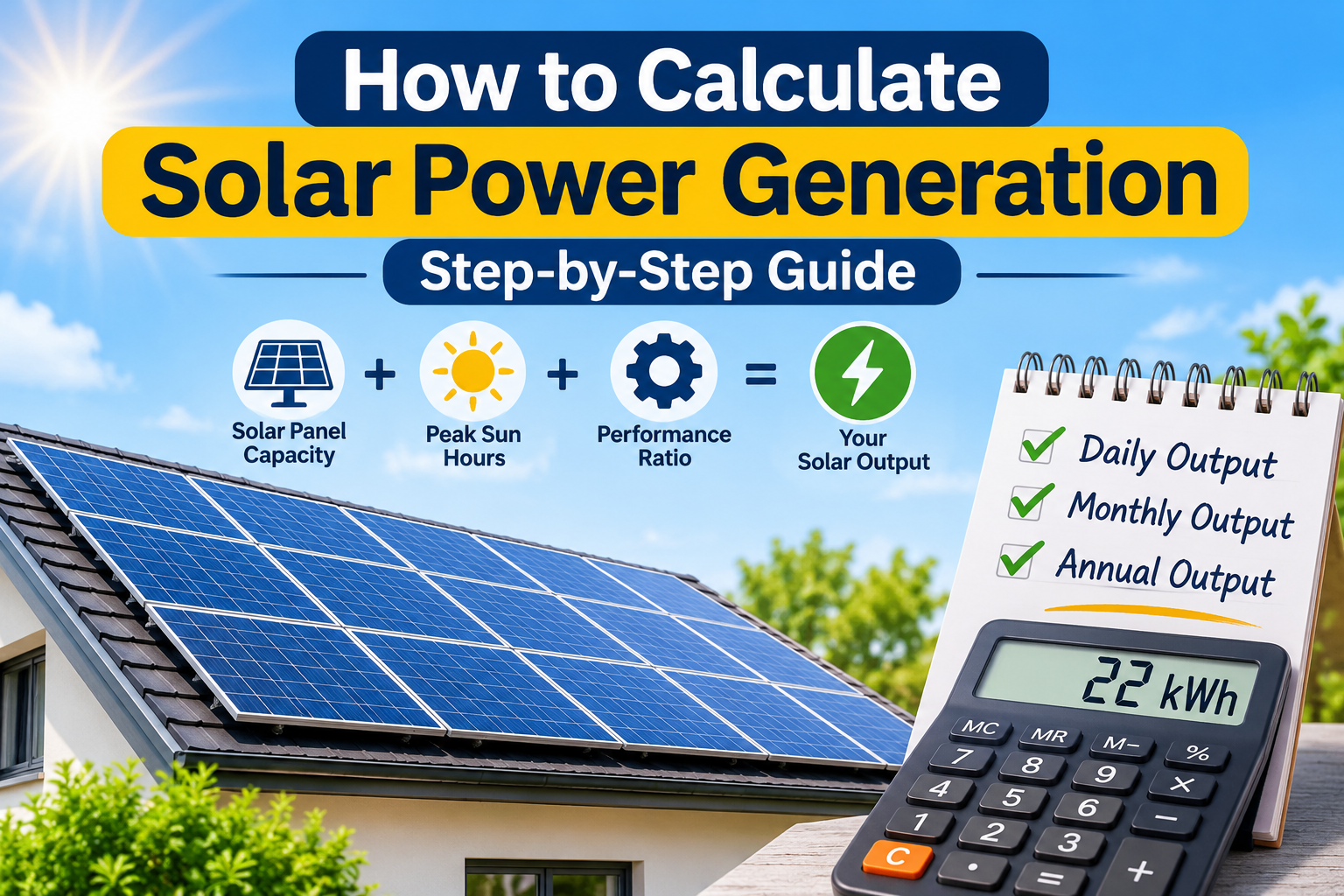
Calculating solar power generation helps us understand how much electricity a solar panel system can produce in a day, month, or year. Whether we’re planning a residential solar installation or evaluating a commercial solar project, knowing the expected energy output makes it easier to choose the right system size and estimate electricity savings.
Calculate solar power generation depends on several factors, including solar panel capacity, peak sun hours, system efficiency, weather conditions, and panel orientation. By using a few simple calculations, we can estimate how much electricity our solar panels will generate and determine whether the system can meet our energy requirements.
Let’s look at the formulas, practical examples, and calculations used to estimate solar power generation accurately.
What Is Solar Power Generation?
Solar power generation refers to the amount of electrical energy produced by solar panels when sunlight reaches their photovoltaic (PV) cells. These cells convert sunlight into direct current (DC) electricity, which an inverter converts into alternating current (AC) electricity for household appliances and other electrical equipment.
Solar power generation is generally measured in kilowatt-hours (kWh). This unit tells us how much electricity a solar system produces over a specific period.
For example, if a solar system generates 20 kWh of electricity in one day, it has produced enough energy to supply appliances with a combined consumption of 20 units of electricity.
We should understand the difference between two common measurements:
- Kilowatt (kW): Measures the power capacity of a solar system.
- Kilowatt-hour (kWh): Measures the amount of electrical energy generated over time.
A 5 kW solar system doesn’t necessarily generate 5 kWh every day. Its actual energy production depends on the number of effective sunlight hours and the system’s operating efficiency.
Table of Contents
How to Calculate Solar Power Generation
The most common method of estimating solar energy production uses system capacity, peak sun hours, and a performance ratio.
We can calculate expected daily solar power generation using this formula:
Daily Solar Power Generation (kWh) = Solar System Capacity (kW) × Peak Sun Hours × Performance Ratio
Each part of this formula has a specific purpose.
1. Determine Your Solar System Capacity
Solar system capacity refers to the maximum rated power output of the installed solar panels under standard test conditions. It’s usually measured in kilowatts (kW).
We can calculate total solar panel capacity by multiplying the wattage of one panel by the total number of installed panels.
Solar System Capacity (kW) = Panel Wattage (W) × Number of Panels ÷ 1,000
For example, suppose we install 10 solar panels, each rated at 550 watts.
The calculation would be:
- Individual panel capacity = 550 watts
- Total panels = 10
- Total capacity = 550 × 10 = 5,500 watts
- Solar system capacity = 5,500 ÷ 1,000 = 5.5 kW
Therefore, our solar installation has a total rated capacity of 5.5 kW.
2. Find the Peak Sun Hours
Peak sun hours represent the equivalent number of hours per day when solar irradiance averages 1,000 watts per square meter.
This measurement helps us estimate how much sunlight energy is available for electricity generation.
For example, a location receiving 5 peak sun hours gets approximately the same daily solar energy as 5 hours of sunlight at an irradiance level of 1,000 W/m².

Peak sun hours vary according to geographical location, season, cloud cover, and weather conditions.
We can obtain location-specific solar radiation estimates from resources such as the Global Solar Atlas or PVGIS.
For our calculation, let’s assume the installation receives 5 peak sun hours per day.
3. Calculate the Solar System Performance Ratio
Solar panels rarely convert their entire rated capacity into usable electricity throughout the day. Energy losses occur because of inverter conversion, temperature, wiring resistance, dust, shading, and other operating conditions.
The performance ratio (PR) accounts for these losses when estimating actual solar electricity production.
A typical planning assumption might be between 0.75 and 0.85, depending on the installation and operating conditions.
Let’s use a performance ratio of 0.80, meaning we estimate that 80% of the theoretical energy output reaches the AC electricity output.
4. Calculate Daily Solar Power Generation
Now we have all the information required to estimate daily electricity production.
Our example includes:
- Solar system capacity: 5.5 kW
- Peak sun hours: 5 hours
- Performance ratio: 0.80
Using the formula:
Daily Generation = 5.5 × 5 × 0.80
Daily Solar Power Generation = 22 kWh
Our 5.5 kW solar system is therefore expected to generate approximately 22 units of electricity per day under these assumed conditions.
Actual production will change with sunlight availability, temperature, shading, and system performance.
How to Calculate Monthly Solar Power Generation
Once we know the expected daily electricity production, estimating monthly output becomes easier.
We can use this formula:
Monthly Solar Generation = Daily Solar Generation × Number of Days
For our 5.5 kW solar installation:
- Daily generation = 22 kWh
- Days in the month = 30
Monthly Generation = 22 × 30
Monthly Solar Power Generation = 660 kWh
This means our system could generate approximately 660 units of electricity in a 30-day month under the same average conditions.
However, monthly production isn’t always consistent. Winter months may have fewer peak sun hours, while summer months can provide longer periods of sunlight. High summer temperatures can also reduce panel efficiency.
For a more accurate monthly estimate, we should use the average daily solar radiation for each month rather than applying one annual average throughout the year.
How to Calculate Annual Solar Power Generation
Annual solar power generation gives us a broader picture of the electricity a solar installation can produce over 12 months.
We can calculate it using:
Annual Solar Generation = Average Daily Solar Generation × 365
Using our previous example:
- Average daily generation = 22 kWh
- Days per year = 365
Annual Generation = 22 × 365
Annual Solar Power Generation = 8,030 kWh
Therefore, our 5.5 kW solar system could generate approximately 8,030 units of electricity annually under the assumed conditions.
For an accurate annual estimate, we should account for seasonal variations and any expected reduction in panel output over time.
Solar Power Generation Calculation Example
Let’s consider another practical example to understand how solar system size affects electricity production.
Suppose we’re planning to install a 10 kW solar system with an average of 5.5 peak sun hours per day and a performance ratio of 0.80.
We can calculate the expected output as follows:
| Calculation | Result |
|---|---|
| Solar system capacity | 10 kW |
| Peak sun hours | 5.5 |
| Performance ratio | 0.80 |
| Daily generation | 44 kWh |
| Monthly generation (30 days) | 1,320 kWh |
| Annual generation (365 days) | 16,060 kWh |
The calculation for daily generation is:
10 × 5.5 × 0.80 = 44 kWh
Our 10 kW solar system could therefore produce approximately 44 units of electricity per day under these assumptions.
This calculation gives us a useful starting point when comparing different solar system capacities.
Factors That Affect Solar Power Generation
Solar electricity production changes throughout the year. Even two installations with identical panel capacities can produce different amounts of electricity because of their location, installation conditions, and equipment.
Here are the main factors we should consider.
Solar Panel Efficiency
Solar panel efficiency determines how effectively a panel converts incoming sunlight into electricity.
For example, a 550-watt panel and a 450-watt panel have different rated power outputs, even if their physical dimensions are similar.
Higher-wattage panels can produce more electricity within the same available installation area, depending on their efficiency and design.
Peak Sun Hours and Weather Conditions
Sunlight availability has a direct effect on solar electricity production.
Clear skies generally allow panels to receive more direct sunlight. Cloudy conditions reduce solar irradiance, which can lower electricity generation.
Rain, fog, and seasonal weather changes can also affect daily output.
Panel Orientation and Tilt Angle
The direction and angle of solar panels influence how much sunlight reaches their surfaces.
In the Northern Hemisphere, including Pakistan, south-facing panels generally receive strong sunlight throughout the day.
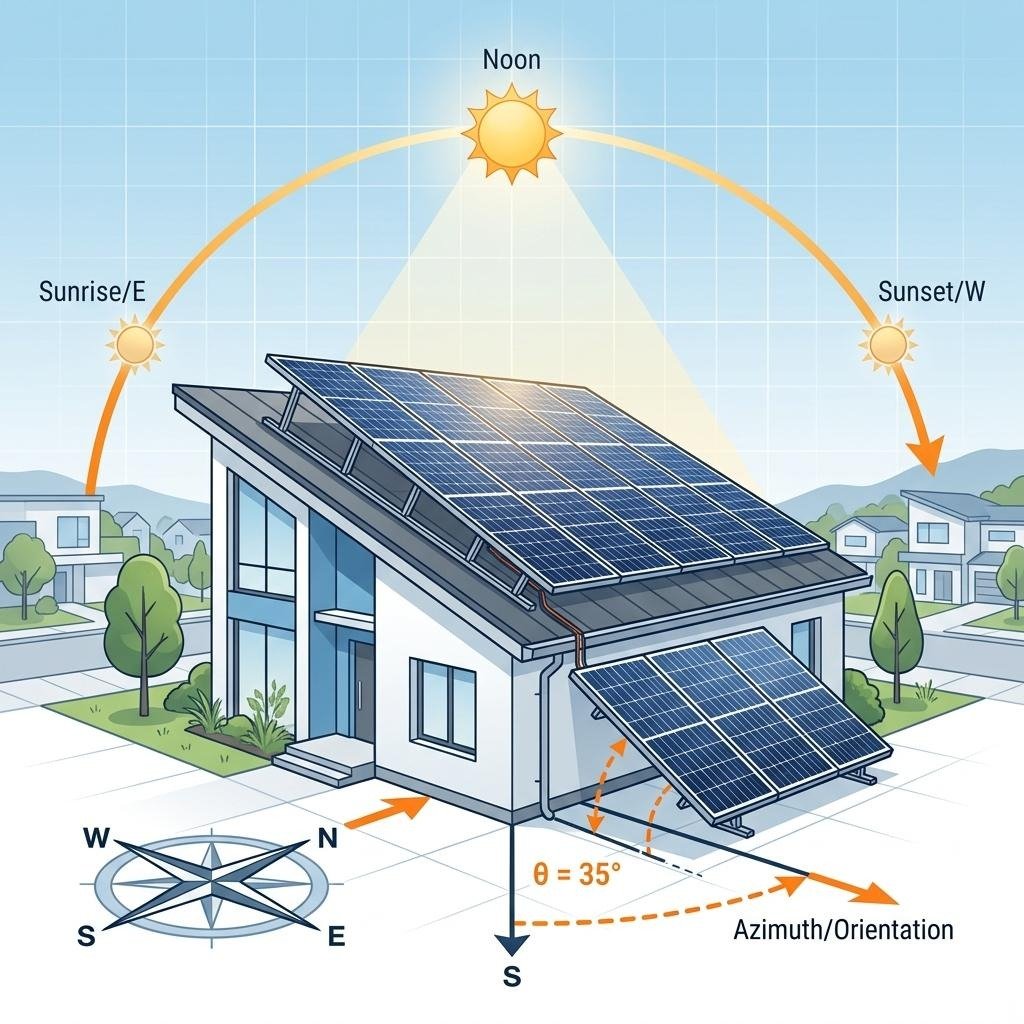
The ideal tilt angle depends on geographical latitude, seasonal production goals, and installation conditions.
Incorrect panel positioning can reduce the total electricity generated over time.
Temperature and Solar Panel Performance
Solar panels perform differently under different temperatures.
Most conventional crystalline silicon panels experience a reduction in power output as their cell temperature rises above standard test conditions.
We can check a panel’s temperature coefficient in its technical datasheet to understand how much its rated power changes with temperature.
Dust and Shading
Dust, bird droppings, leaves, and other surface obstructions can reduce the sunlight reaching photovoltaic cells.

Shading from nearby buildings, trees, antennas, or other objects can also affect electricity production. Depending on the system design, even partial shading can cause noticeable output losses.
Regular inspection and appropriate panel cleaning help maintain expected production.
Inverter and Electrical Losses
Solar panels produce DC electricity, while most household electrical appliances operate on AC electricity.
The inverter converts DC into AC, and this process involves some energy loss.
Additional losses can occur through cables, electrical connections, system components, and battery charging.
These losses are included in the performance ratio when we estimate actual system production.
How to Calculate Solar Power Generation Using Panel Wattage
We can also estimate electricity generation directly from the number and wattage of solar panels.
The formula is:
Daily Generation (kWh) = Total Panel Wattage (W) × Peak Sun Hours × Performance Ratio ÷ 1,000
For example, suppose we install 8 solar panels rated at 500 watts each.
Our system capacity is:
8 × 500 = 4,000 watts
Next, we assume 5 peak sun hours and a performance ratio of 0.80.
Daily Generation = 4,000 × 5 × 0.80 ÷ 1,000
Daily Generation = 16 kWh
Therefore, our 4 kW solar system could generate approximately 16 units of electricity per day under these assumptions.
This method is particularly useful when we know the individual panel wattage but haven’t calculated the total system capacity yet.
How to Calculate Solar Power Generation for Your Home
Before choosing a solar system, we should understand how much electricity our home consumes.
The easiest way is to review previous electricity bills and calculate average monthly consumption.
For example, suppose our monthly electricity usage is 600 kWh.
We can estimate daily consumption:
600 ÷ 30 = 20 kWh per day
Now, let’s assume our location receives 5 peak sun hours daily and our solar system has a performance ratio of 0.80.
We can calculate the required solar system capacity using:
Required Solar Capacity (kW) = Daily Electricity Consumption (kWh) ÷ (Peak Sun Hours × Performance Ratio)
Required Capacity = 20 ÷ (5 × 0.80)
Required Capacity = 20 ÷ 4
Required Solar Capacity = 5 kW
Based on these assumptions, a 5 kW solar system could generate approximately 20 kWh daily.
Actual system sizing should also account for seasonal electricity demand, available roof space, inverter capacity, battery requirements, and the applicable grid connection rules.
How to Calculate Solar Power Generation Using Capacity Factor
Another method for estimating solar electricity production uses the capacity factor.
Capacity factor measures the actual energy generated over a period compared with the energy the system would generate if it operated continuously at its rated capacity.
We can calculate annual generation using:
Annual Generation (kWh) = Solar System Capacity (kW) × 8,760 × Capacity Factor
For example, assume we have a 10 kW solar system with an annual capacity factor of 18%.
Annual Generation = 10 × 8,760 × 0.18
Annual Generation = 15,768 kWh
This method is useful when we have an estimated annual capacity factor for a specific location or installation.
The capacity factor depends on solar radiation, equipment performance, shading, downtime, and other operating conditions.
How to Estimate Solar Power Generation in Pakistan
Pakistan receives substantial solar radiation across many regions, making solar energy a practical electricity source for residential, commercial, and industrial properties.
However, expected solar production varies between cities and throughout the year.
For example, Lahore, Karachi, Islamabad, and Quetta have different weather patterns and solar radiation conditions. We should use location-specific solar data when estimating electricity production for a particular installation.
To calculate expected solar power generation in Pakistan, we can follow these steps:
- Determine the total rated capacity of the solar panels.
- Find the average daily peak sun hours for the installation location.
- Select a realistic performance ratio based on the system design.
- Multiply system capacity by peak sun hours and performance ratio.
- Calculate monthly and annual production using monthly solar radiation data.
The Global Solar Atlas is a useful resource for checking solar photovoltaic power potential by location.
We should also consider high summer temperatures, dust accumulation, monsoon weather, and shading when estimating actual electricity generation.
Frequently Asked Questions About Solar Power Generation
1. How do we calculate solar power generation per day?
We multiply the total solar system capacity in kilowatts by daily peak sun hours and the system performance ratio.
Formula: Daily Generation = System Capacity × Peak Sun Hours × Performance Ratio.
For example, a 5 kW system receiving 5 peak sun hours with an 80% performance ratio can generate approximately 20 kWh daily.
2. How many units of electricity does a 5 kW solar system generate?
A 5 kW solar system receiving 5 peak sun hours daily with a performance ratio of 0.80 can generate approximately 20 units of electricity per day.
Its estimated monthly generation would be 600 units over 30 days.
3. How much electricity does one 550-watt solar panel produce per day?
Assuming 5 peak sun hours and a performance ratio of 0.80:
550 × 5 × 0.80 ÷ 1,000 = 2.2 kWh.
Therefore, one 550-watt solar panel could generate approximately 2.2 units of electricity per day under these conditions.
4. How do we calculate solar power generation per month?
Multiply average daily electricity generation by the number of days in the month.
For example, if a solar system produces 20 kWh daily, its estimated 30-day production is:
20 × 30 = 600 kWh.
5. What is the difference between kW and kWh in solar power?
Kilowatts (kW) measure the rated power capacity of a solar installation, while kilowatt-hours (kWh) measure the electrical energy generated or consumed over time.
A 5 kW solar system producing electricity for 4 equivalent full-power hours generates 20 kWh before accounting for system losses.
6. Does weather affect solar power generation?
Yes. Cloud cover, rain, fog, and dust can reduce the sunlight reaching solar panels.
High temperatures can also reduce panel efficiency, even when sunlight is strong.
7. How can we increase solar power generation?
We can improve solar electricity production by keeping panels clean, reducing shading, selecting suitable panel orientations, using properly sized inverters, and maintaining electrical connections.
Regular system monitoring also helps us identify unexpected drops in energy production.
Final Thoughts
Calculating solar power generation helps us estimate the electricity a photovoltaic system can produce before installation. By using solar panel capacity, peak sun hours, and the performance ratio, we can calculate expected daily, monthly, and annual energy production.
The basic formula is simple:
Solar Power Generation = System Capacity × Peak Sun Hours × Performance Ratio
We can use this calculation to compare solar system sizes, estimate household electricity production, and plan installations according to expected energy requirements. For better accuracy, we should use location-specific solar radiation data and account for seasonal changes and actual system losses.