Solar panels need sunlight to produce electricity, so their output changes throughout the day.
At night, the panels stop producing electricity. During cloudy weather, they can still generate power, but output falls as less sunlight reaches the panels. The U.S. Department of Energy explains that clouds, dust and other atmospheric conditions affect the amount of solar radiation reaching a PV system.
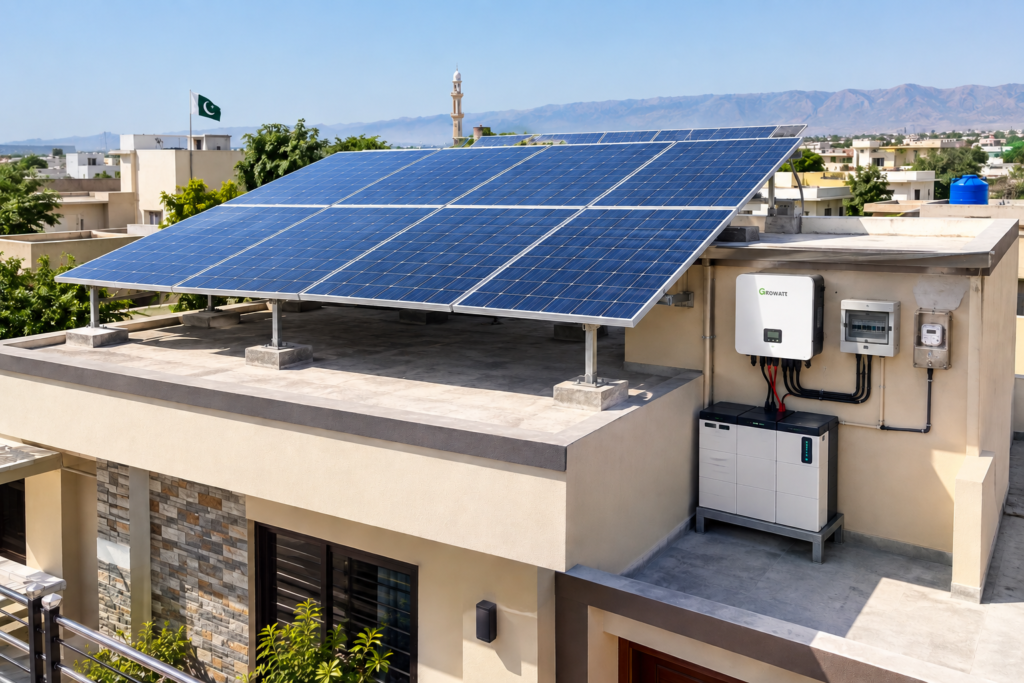
So what happens to your house after sunset?
That depends on the type of solar system for house you install.
On-grid solar
An on-grid system stays connected to the electricity grid.
During daylight hours, your panels generate electricity for your home. When production is lower than your demand, your house can draw electricity from the grid, subject to the applicable utility and prosumer rules.
Hybrid solar
A hybrid system adds a battery.
Your panels can charge the battery during the day, and the stored electricity can then be used after sunset or during a power outage. Battery storage can also keep selected household loads running when the grid is unavailable.
Off-grid solar
An off-grid house depends on its own solar generation and energy storage.
That means the system needs enough generation and battery capacity for periods when solar production is low. This can make off-grid systems considerably more demanding to design.
There’s another point Pakistani homeowners should know.
A standard grid-tied solar system generally shuts down when the grid goes out. A battery-backed system needs the correct inverter and backup configuration to keep supplying the house during an outage.
The practical answer: solar panels produce electricity mainly during daylight, while the grid or battery can cover your needs when solar production is unavailable.
Myth 2: Every house needs the same size solar system
Your neighbour may have a 5kW system. That doesn’t mean a 5kW system is right for your house.
The correct size depends mainly on your electricity consumption, when you use electricity, available roof space, shading and the type of system you choose.
A house running 2 ACs, a water pump, refrigerator, washing machine and several fans can have a very different load from a smaller house using only fans, lights and basic appliances.
Start with your electricity units
Look at your electricity bills and check the units consumed, measured in kWh.
It’s better to look at several months rather than choosing a system from one unusually high or low bill. Summer consumption can be much higher when ACs run for long hours.
For example, two houses can have the same roof size but completely different electricity needs.
One may use 300 units per month. Another may use 900 units because of multiple ACs and other heavy loads.
Their solar requirements won’t be the same.
Roof space also matters
A solar system for home needs enough usable roof area for the panels.
Shade from another building, water tank, boundary wall, trees or nearby structures can reduce production. Panel direction, roof angle and the amount of sunlight reaching the roof also affect system output.
That’s why a proper site assessment matters before you pay for equipment.
If you’re unsure about system size, use your monthly electricity units as the starting point and then check the roof and load requirements.
Myth 3: Installing solar means your electricity bill will become zero
A solar system can reduce your electricity bill substantially, but a zero bill isn’t something an installer should promise without checking your actual consumption and system design.
Your panels generate electricity according to available sunlight. Your house consumes electricity according to your appliances and usage habits.
If your home uses more electricity than your solar system is producing at a particular time, you need another source of electricity.
With an on-grid system, that source can be the grid.
With a hybrid system, a battery can supply some of the demand, depending on its capacity and the loads connected to the backup circuit.
Your system type matters
Suppose your panels produce electricity at noon while your family is away from home.
You may have excess generation at that time.
Then, after sunset, your panels stop generating while your lights, fans, refrigerator and other appliances continue using electricity.
What happens to that excess daytime electricity depends on your system and the applicable electricity rules.
Pakistan’s regulatory framework has changed in 2026. NEPRA notified the Prosumer Regulations 2026 in February and subsequently listed amendments, so homeowners should check the current rules before making financial calculations based on electricity exports.
That matters when you’re comparing an on-grid system with a hybrid system.
A quote based on old net-metering assumptions can give you the wrong financial picture.
Your electricity habits matter too
If you run your AC, washing machine, water pump or other heavy appliances during daylight hours, you can directly use more of the solar electricity your panels are producing.
If most of your electricity use happens at night, battery storage may become more relevant.
The right setup depends on your actual load pattern, not just the number printed on your electricity bill.
Solar System Size Calculator used for this purpose.
Myth 4: Solar panels don’t need any maintenance
Solar panels don’t have many moving parts, but your home solar system still needs basic maintenance.
Dust is one of the practical issues Pakistani homeowners need to consider.
Dust and dirt can reduce the sunlight reaching the panel surface and lower energy production. The U.S. Department of Energy notes that cleaning requirements depend on local conditions such as dust, pollution, pollen and other sources of soiling.
This matters even more in areas where dust builds up quickly.
What needs checking?
A basic maintenance routine can include:
- Checking panel surfaces for heavy dust or dirt
- Monitoring inverter performance
- Checking cables and electrical connections
- Inspecting mounting structures
- Looking for visible panel damage
- Checking battery condition if your system has storage
- Reviewing system production for unusual drops
You don’t need to treat every small amount of dust as an emergency.
The cleaning frequency depends on your location and how quickly dirt accumulates on your panels.
The inverter also deserves attention because it’s the part converting the DC electricity from your panels into AC electricity used by your home.
If production suddenly falls without a clear change in weather or household usage, check the system rather than assuming the panels have simply become less efficient.
Manufacturer warranty documents matter here too. Before buying, check the panel product warranty, inverter warranty and battery warranty separately.
Myth 5: Solar is only worth it for homes with very high electricity bills
A high electricity bill can make the financial case for solar stronger, but the bill amount alone doesn’t decide whether a solar system for house makes sense.
Your electricity consumption, tariff, solar generation, system cost, battery requirement and how much solar electricity you use directly all affect the numbers.
A smaller home using 300 to 400 units per month may still benefit from solar.
A larger house using 1,000 units may need a much larger system, but its upfront cost will also be higher.
Think about consumption, not just the bill
Electricity tariffs can change.
So can solar equipment prices.
And your electricity use can change if you add another AC, electric water heater, pump, EV charger or other major appliance.
That’s why a solar calculation based only on your current bill can become outdated.
For a better estimate, collect several recent electricity bills and look at:
- Monthly units consumed
- Daytime electricity use
- Evening and night usage
- Major appliances
- Available roof area
- Shading
- Your need for backup power
- Your budget for batteries
A home with frequent load shedding may choose a hybrid system because backup power matters to the household.
Another home may prefer an on-grid setup because its main goal is reducing grid electricity use.
Both can be sensible choices.
What to check before buying a solar system for your house
Once you move past the myths, the buying decision becomes much easier.
Start with these questions.
1. How many units do you use?
Use several electricity bills rather than one month.
Your summer and winter consumption can be very different in Pakistan.
2. How much electricity do you use during the day?
This matters when comparing an on-grid system with a hybrid system and battery storage.
A house that consumes a lot of electricity while the sun is available can directly use more solar generation.
3. Is your roof suitable?
Check usable roof area, shading, panel orientation and structural conditions.
A large roof with heavy shade can be less useful than a smaller roof with good sunlight.
4. Do you need backup during load shedding?
If you need selected appliances to keep running during outages, ask exactly which circuits the battery will supply.
Don’t assume that a battery will automatically run every appliance in your house.
5. Which inverter are you buying?
Check the exact inverter model, rated capacity, warranty, battery compatibility and monitoring system.
The inverter is a major part of the system, so the brand name alone isn’t enough.
6. What panel model is included?
Ask for the exact panel model and datasheet.
Compare wattage, efficiency, temperature coefficient, warranty and degradation terms rather than comparing only the brand name.
7. What does the quotation include?
A solar quotation should clearly show whether the price includes:
- Solar panels
- Inverter
- Mounting structure
- DC and AC wiring
- Protection equipment
- Earthing
- Installation
- Monitoring
- Battery, if applicable
- Applicable application or connection costs
This prevents you from comparing a low equipment-only quote with a complete installation quote.
A solar system for house should be sized around your real usage
The easiest way to avoid the myths is to start with your own electricity data.
Take your recent bills, check your monthly units, list your major appliances and look at how much electricity you use during daylight hours.
Then check your roof.
Pakistan has strong solar resources across much of the country. World Bank solar-resource data for Pakistan includes long-term measurements and PV potential data used for assessing solar generation potential.
Your actual production will still depend on your city, season, panel orientation, shading, temperature, dust, system design and equipment losses.
That’s why a solar system for house should be sized from your own electricity use and roof conditions rather than copying the system installed at another house.
FAQs
What is the best solar system for a house in Pakistan?
The right system depends on your electricity consumption, daytime usage, roof space and backup needs. An on-grid system can suit a home focused on reducing grid electricity use, while a hybrid system can make more sense when battery backup is a priority.
How many solar panels does a house need?
There is no single number for every house. Panel count depends on the required system capacity and the wattage of the panels you choose.
For example, a 5kW system using 585W panels would require around 9 panels because 9 × 585W equals 5.265kW of panel capacity.
Does a home solar system work at night?
Solar panels stop producing electricity after sunset. Your house can still use electricity from the grid or from a battery, depending on your system design.
Can solar completely eliminate an electricity bill?
It can reduce your bill substantially, but a zero bill isn’t guaranteed. Your result depends on system size, electricity consumption, solar production, battery use and the current rules for electricity imports and exports.
Do solar panels need cleaning in Pakistan?
They can. Dust and dirt can reduce the amount of sunlight reaching the panels, so the cleaning frequency should match local conditions.
Is a battery necessary for a home solar system?
No single setup works for every house. A battery becomes more relevant when you need backup during load shedding or when you want to use stored solar electricity after sunset.
Next step
Before asking an installer for a quote, check your last few electricity bills and note your monthly units.
Then estimate your required system size, check your usable roof space and decide whether you need battery backup. After that, compare quotes using the same equipment and inclusions, so you’re comparing like with like.