
Monocrystalline vs Polycrystalline Solar Panels: Which One Should You Buy?
Choosing between monocrystalline and polycrystalline solar panels can feel confusing when both types are sitting on the same dealer’s price list.
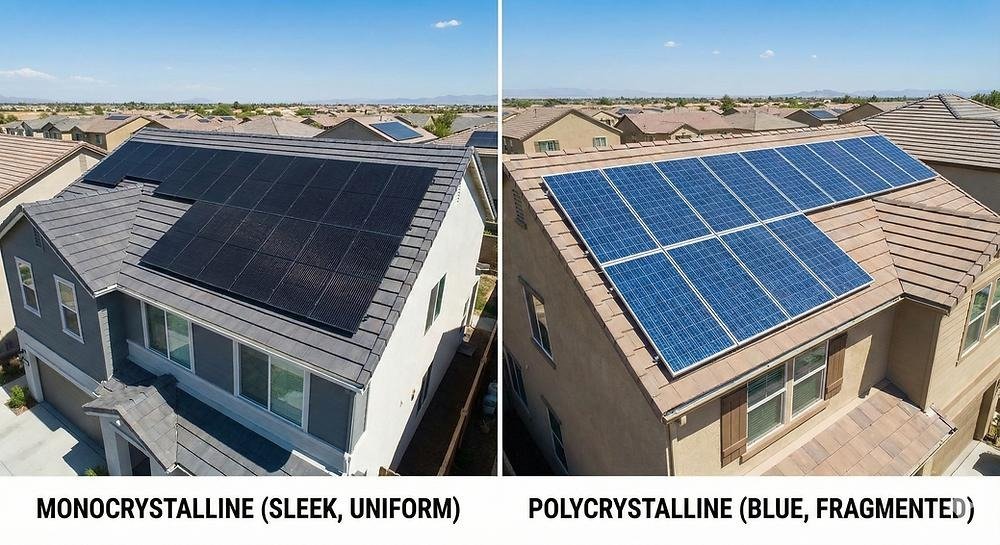
The basic difference comes down to how the solar cells are made. That difference affects efficiency, appearance, space requirements, temperature performance, and price.
If you’re planning a solar system for your home or business, those details matter.
What are monocrystalline solar panels?
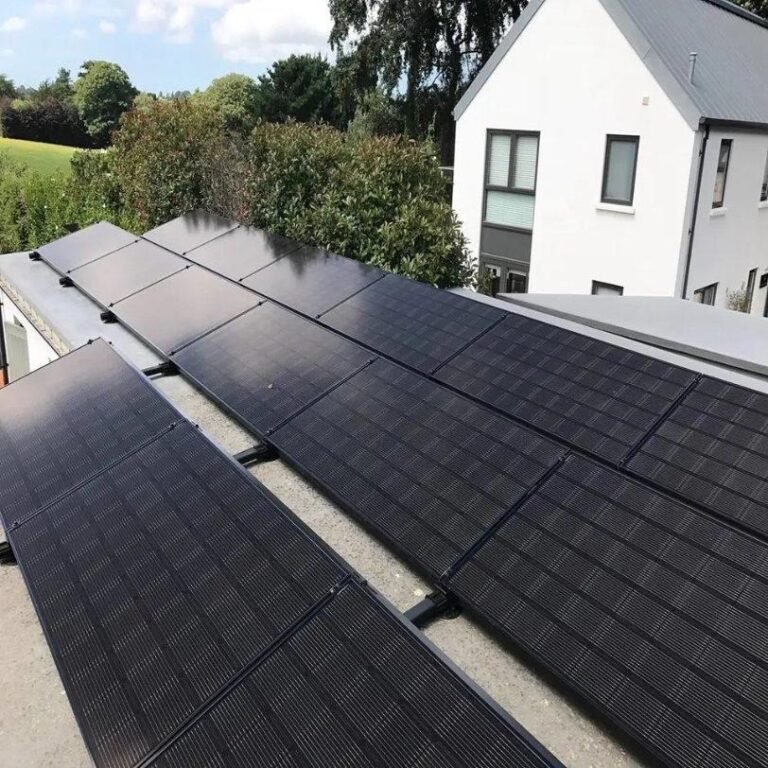
Monocrystalline solar panels are made from solar cells cut from a single silicon crystal.
The cells usually have a dark black appearance, which is why you’ll often see black solar panels on modern rooftops. Their uniform look also makes them popular for residential installations.
A typical monocrystalline panel has a higher efficiency rating than an older polycrystalline panel of the same physical size.
For example, a modern 550W monocrystalline panel can produce 550 watts of rated power while taking up roughly 2.2 to 2.4 square meters of roof space, depending on the model.
That’s useful when your roof area is limited.
What are polycrystalline solar panels?
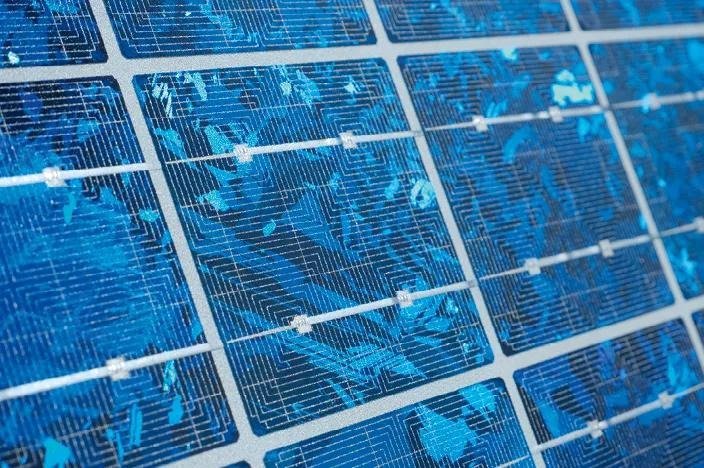
Polycrystalline panels are made by melting silicon fragments together and forming them into a block. The block is then cut into wafers and used to make solar cells.
Their blue appearance makes them easy to recognize. You may still see them on older installations, commercial buildings, and budget-focused solar projects.
Polycrystalline panels historically had lower efficiency than monocrystalline panels. They also tended to require more roof space for the same total system capacity.
Technology has changed quickly, though. Modern panel specifications matter more than simply choosing a panel based on the word “mono” or “poly.”
Monocrystalline vs polycrystalline solar panels : Quick Comperison
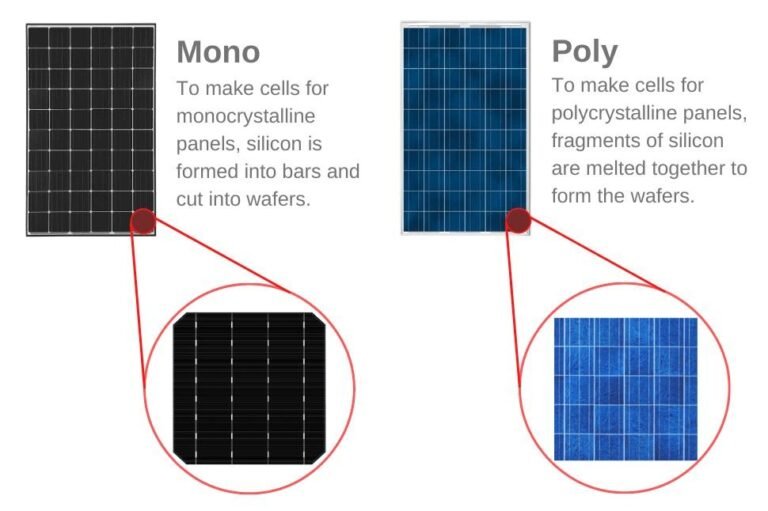
Here’s the basic comparison:
| Feature | Monocrystalline | Polycrystalline |
|---|---|---|
| Cell material | Single-crystal silicon | Multiple silicon crystals |
| Typical appearance | Black or dark | Blue |
| Efficiency | Generally higher | Generally lower |
| Space required | Less for the same power | More for the same power |
| Low-light performance | Generally better | Generally lower |
| Price | Usually higher | Usually lower |
| Roof suitability | Excellent for limited space | Better where space is available |
| Common use today | Homes, businesses, large solar systems | Older and budget installations |
These are general differences. The exact numbers depend on the panel model, cell technology, power rating, and manufacturer.
Efficiency: mono usually has the edge
Efficiency tells you how much sunlight a panel converts into usable electricity.
Suppose you have 2 panels with the same physical dimensions. One produces 450W and the other produces 550W. The 550W panel is putting more electrical output into roughly the same amount of roof space.
That’s one reason monocrystalline panels are common in new residential systems.
A homeowner with a small roof may care about every square meter. Higher wattage and efficiency can help fit the required system capacity without covering the entire roof.
Polycrystalline Panels Need more Space
Let’s say you’re building a 5kW solar system.
If your selected panels are rated at 500W, you’d need 10 panels to reach 5kW of panel capacity.
A 550W panel would require about 10 panels as well if you want a little extra capacity, but panel dimensions and layout still matter. The actual roof requirement depends on the specific model.
This is why you shouldn’t calculate roof space from wattage alone.
Check the panel’s dimensions before buying.
Which panel works better in hot weather?
Solar panels work in hot climates, but their electrical output generally falls as cell temperature rises above the temperature used for the panel’s rated test conditions.
This matters in places such as Pakistan, where summer temperatures can become very high.
The number you should check is the temperature coefficient of power.
For example, a panel with a temperature coefficient of -0.29%/°C loses less power as temperature rises than one rated at -0.35%/°C, assuming the other conditions are comparable.
So when you’re comparing panels for a hot climate, look at the datasheet rather than relying only on “mono” or “poly.”
Monocrystalline panels in Pakistan
Monocrystalline panels are widely used in residential and commercial solar installations in Pakistan.
You’ll see models from brands such as Longi, Jinko, and Canadian Solar in local solar markets.
A typical homeowner may choose monocrystalline panels because roof space is limited and higher-wattage panels can produce more power from each panel.
For example, if you’re planning a 10kW system, using 550W panels would require around 19 panels to reach 10.45kW of panel capacity.
That can make the physical layout easier than using a larger number of lower-wattage panels.
When can polycrystalline panels make sense?
Polycrystalline panels can still make sense when the purchase price matters heavily and you have plenty of installation space.
Imagine a large warehouse roof with lots of unused area. You have more freedom to use larger numbers of lower-efficiency panels.
The calculation then becomes a question of total installed cost, available roof area, panel specifications, and expected electricity production.
For an older solar project, replacing every panel with a newer mono panel may also require additional planning. Panel dimensions, mounting rails, wiring, and inverter capacity all need to be checked.
Mono vs poly: price difference
Monocrystalline panels have traditionally cost more because their manufacturing process was more expensive.
That price gap has changed over the years as manufacturing has improved and the solar industry has shifted heavily toward monocrystalline technologies.
So don’t assume that a polycrystalline panel will always be significantly cheaper.
Local prices can change because of exchange rates, imports, stock levels, manufacturer, panel wattage, and dealer margins.
If you’re shopping in Pakistan, compare the price per watt.
For example:
- Panel A: Rs. 32,000 for 550W
- Panel B: Rs. 29,000 for 500W
Panel A costs about Rs. 58.18 per watt.
Panel B costs Rs. 58 per watt.
The cheaper panel by total price isn’t automatically cheaper per watt.
Which one lasts longer?
Both monocrystalline and polycrystalline panels can have long service lives.
The manufacturer’s warranty tells you more than the cell type alone.
Many modern panels come with a product warranty and a separate performance warranty. The exact terms vary by manufacturer and model.
Before buying, check:
- Product warranty period
- Performance warranty
- Expected degradation
- Panel certification
- Manufacturer specifications
- Local warranty support
A cheap panel with poor after-sales support can create headaches later.
Appearance can matter too
Mono panels are usually black or very dark.
Poly panels tend to have a blue appearance caused by the way light interacts with their crystalline structure.
If you’re installing panels on a house where the roof is visible from the street, you may prefer the darker appearance of monocrystalline panels.
For a large industrial roof, appearance usually has less practical importance.
Monocrystalline vs polycrystalline for limited roof space
This is where the difference becomes easy to understand.
You have a small roof and want a 10kW system.
You need enough panel capacity to reach your target. Higher-wattage panels can reduce the number of panels required, although the exact roof area still depends on panel dimensions.
With limited space, monocrystalline panels generally make more sense because current models tend to provide higher power and efficiency.
A solar installer should measure the usable roof area before recommending a panel layout.
Chimneys, water tanks, parapet walls, shade, walkways, and maintenance access all take away usable space.
What about cloudy or low-light conditions?
Solar panels can generate electricity under cloudy skies, although output falls when sunlight becomes weaker.
Monocrystalline panels have generally had an advantage in low-light conditions, but the actual result depends heavily on the panel design.
Look at the manufacturer’s electrical specifications and independent testing where available.
A panel’s cell technology tells you part of the story. The complete datasheet tells you much more.
Which one is better for a 5kW home system?
For a new 5kW residential installation, monocrystalline panels are usually the type you’ll encounter most often.
A 550W panel would need around 10 panels to provide 5.5kW of DC capacity.
That extra panel capacity can give the inverter more energy to work with during periods when actual sunlight is below ideal conditions, although the inverter’s permitted DC input and design limits must be checked.
Your installer should size the inverter and panels as one system.
Don’t choose the panels first and figure out the inverter afterward.
Which one is better for a 10kW system?
A 10kW system needs more planning because the panel count, inverter capacity, roof layout, cable sizing, protection equipment, and load profile all become more significant.
With 550W panels, 18 panels give you 9.9kW of DC capacity.
19 panels give you 10.45kW.
That doesn’t automatically mean 19 panels are the correct choice. Your inverter specification, roof orientation, local electricity rules, and expected loads all matter.
For most new residential and small commercial installations, modern monocrystalline panels are likely to be the practical starting point.
Are polycrystalline panels still available?
Yes.
You’ll still find polycrystalline panels in some markets and older solar installations.
But the solar industry has moved strongly toward monocrystalline cell technology. Current product ranges from major manufacturers are heavily focused on newer mono-based designs.
If a dealer recommends an older polycrystalline panel, check the exact model, warranty, efficiency, condition, and price per watt.
A panel being “poly” doesn’t automatically make it a bad purchase. The numbers have to make sense for the installation.
How to choose the right solar panel
- Start with your electricity requirement.
- Then check your available roof area.
- After that, compare actual panel specifications.
1. Check the wattage
A higher-wattage panel can reduce the number of panels required for a given system size.
But wattage alone isn’t enough.
2. Check efficiency
Efficiency matters when roof space is limited.
Compare the percentage listed on the manufacturer’s datasheet.
3. Check temperature coefficient
Pakistan’s hot summers make this specification worth checking.
A less negative power temperature coefficient generally means less output loss as cell temperature increases.
4. Check dimensions
Two 550W panels can have different dimensions.
Measure the usable roof area before ordering panels.
5. Check warranty terms
Read the actual warranty document.
Don’t rely only on a dealer’s verbal promise.
6. Check the manufacturer and model
Write down the exact panel model number.
Then compare the datasheet, warranty, dimensions, efficiency, and temperature coefficient.
This takes a few minutes and can save you from buying the wrong panel for your system.
Monocrystalline vs polycrystalline: final comparison
For a new solar installation, the decision usually comes down to your roof area, budget, panel specifications, and expected electricity production.
Monocrystalline panels generally provide higher efficiency and more power from a given roof area. They’re a common choice for modern residential and commercial systems.
Polycrystalline panels can still work well where installation space is plentiful and the purchase price makes sense.
If you’re comparing 2 actual panels, send me their model numbers and prices. Compare the datasheets, price per watt, efficiency, temperature coefficient, warranty, dimensions, and expected system capacity before making the purchase.
FAQs
Are monocrystalline solar panels better than polycrystalline?
Monocrystalline panels generally have higher efficiency and need less space for the same power output. The better option for a specific installation depends on price, roof area, panel specifications, and system design.
Are polycrystalline solar panels cheaper?
Polycrystalline panels have traditionally been cheaper, but the price difference depends on the current market and specific models. Compare the price per watt instead of looking only at the total panel price.
Which solar panel is best for Pakistan?
For a new installation, modern monocrystalline panels are widely used in Pakistan. Check efficiency, temperature coefficient, warranty, dimensions, manufacturer, and price before choosing a specific model.
Do monocrystalline panels work better in hot weather?
Panel output generally decreases as cell temperature rises. The temperature coefficient of power gives you a better way to compare hot-weather performance between specific models.
Which panel needs less roof space?
Monocrystalline panels generally need less roof space for the same rated power because current models tend to have higher efficiency.
Can I mix monocrystalline and polycrystalline panels?
It’s technically possible in some system designs, but panel electrical characteristics, string configuration, inverter limits, voltage, current, and shading conditions must be checked first. Mixing panels without proper system design can reduce performance.
How long do solar panels last?
Modern solar panels are designed for decades of operation. Check the specific manufacturer’s product and performance warranties because coverage and degradation limits vary between models.
Should I buy a 550W monocrystalline panel?
A 550W panel can be a good fit when its dimensions, efficiency, temperature coefficient, warranty, price per watt, and electrical specifications suit your system. Check the complete datasheet before buying.