Canadian Solar Panels: Price, Quality & Longi Comparison
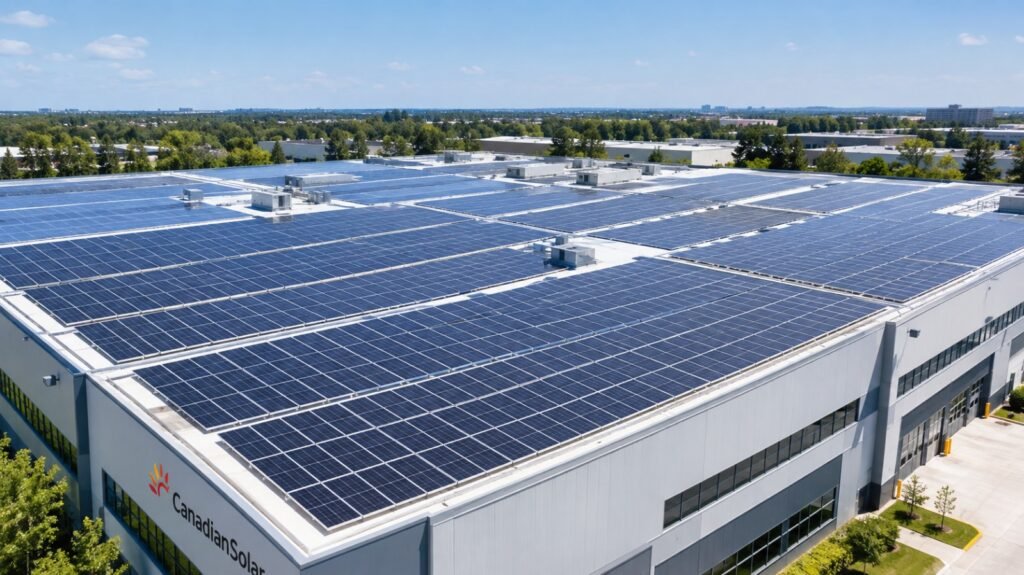
Canadian Solar panels are the solar panels that turn sunlight into electricity. They are made by Canadian Solar Inc., a company that makes solar panels.
In simple words, Canadian Solar panels do the same work as other solar panels. They take sunlight and turn it into electricity that you can use at home. Canadian Solar is a well-known solar panel brand and has been in the market for many years. The reason many people choose it is that they get good quality at a price that is mostly reasonable.
The 10% discount: trap or smart buy?
Canadian Solar consistently undercuts Longi and Jinko on price. This is not a clearance sale. It is their core business model.
Longi is heavily vertically integrated. They manufacture their own silicon wafers, cells, and modules. They control every step and charge a premium for that quality assurance.
Canadian Solar focuses primarily on module assembly. They buy a large portion of their solar cells from third-party manufacturers. This reduces their factory overhead. They pass those savings to the distributor, who passes them to you.
You are not buying inferior technology. You are buying a panel assembled by a company with lower operational costs. For a residential roof, that 10% savings translates to hundreds of dollars. That money is better spent on a higher quality hybrid inverter.
The wattage wars: HiKu6 vs HiKu7
Canadian Solar loves big glass. They were among the first to push module wattages past the 600W mark.
Their current lineup is dominated by two series.
The HiKu6 Series (550W to 670W)
These use 182mm or 210mm silicon wafers. A standard 660W HiKu6 panel measures 2384mm by 1303mm. It weighs 32.2 kg. This is the sweet spot for commercial roofs and large residential setups.
The HiKu7 Series (700W+)
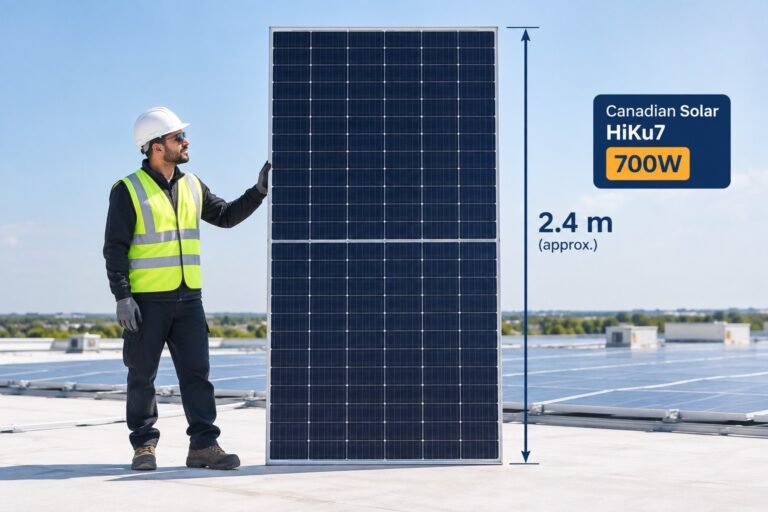
These are absolute monsters. A 700W panel stretches over 2.4 meters long.
Installers love the HiKu7. Fewer panels mean fewer mounting rails, less wiring, and faster installation times. But there is a physical limit to glass.
When a panel gets that large, it becomes flexible. Wind hitting a 2.4-meter sail creates immense mechanical stress. If your mounting structure is weak, the panel will flex, bow, and eventually shatter. Buy the HiKu7 only if you have a flat, reinforced commercial roof or an open ground mount. Stick to the HiKu6 for standard pitched roofs.
The micro-crack reality (The hidden risk)
Size creates vulnerability. This is the biggest secret in solar logistics.
Canadian Solar ships thousands of containers globally. During transit from factories in Asia to local ports, trucks vibrate. Cranes drop pallets.
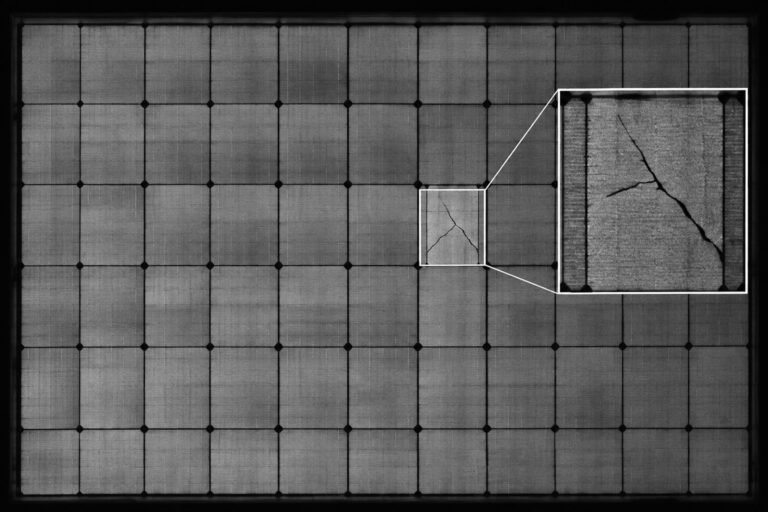
Large, thin panels absorb this kinetic energy. The glass does not break, but the silicon cells underneath develop microscopic fractures. These are called micro-cracks.
A panel with micro-cracks works fine on day one. But as temperatures expand and contract the frame over five years, those cracks widen. A cell stops producing power. You get a dead spot.
You must protect your investment.
- Demand an EL (Electroluminescence) test report from your dealer.
- This test acts like an X-ray for solar panels. It highlights micro-cracks in dark lines.
- Refuse delivery if the dealer cannot provide a clean EL test batch report for your specific serial numbers.
Catching up: The CS6N TOPCon series
For years, Canadian Solar relied on P-type PERC cells. They were cheap but degraded faster in high heat. The industry has moved on.
Canadian Solar’s answer is the CS6N series. This uses N-type TOPCon (Tunnel Oxide Passivated Contact) technology.
The engineering shift is massive. N-type cells use a different phosphorus doping process that makes them highly resistant to light-induced degradation (LID).
Here is what the CS6N brings to your roof:
- Peak Efficiency: 22.5% conversion rate.
- Bifaciality: Up to 85% rear-side power generation if installed on a white reflective roof.
- Degradation: Only 1% loss in the first year, followed by a 0.4% annual drop.
If you are buying Canadian Solar today, ignore the older CS3K or CS3W P-type models. The CS6N TOPCon series matches Longi’s Hi-MO 6 in performance while maintaining that 10% price advantage.
Installation rules for massive panels
You cannot mount a 660W Canadian Solar panel like an old 300W module. The physical dimensions require strict structural engineering.
Follow these rules during installation:
- Rail spacing: The mounting rails must be placed exactly at the manufacturer’s designated clamp zones. Placing a rail too close to the center of a 2.3-meter panel will cause it to sag under snow or wind weight.
- Mid-clamps: Use heavy-duty anodized aluminum mid-clamps. Plastic clips will snap under the thermal expansion of large frames.
- Tilt angle: Keep the tilt between 15 and 30 degrees. Large panels accumulate dust faster at lower angles, which creates hot spots.
Warranty claims in the grey market
Canadian Solar offers a standard 12-year product warranty and a 25-year linear performance warranty. They guarantee the panel will still produce 84.8% of its original output in year 25.
There is a catch.
Local distributors frequently go out of business. When your panel fails in year seven, the shop you bought it from is gone.
Canadian Solar will not process your claim without proof of purchase from an authorized channel.
Register your system immediately after installation. Go to the official Canadian Solar customer portal. Upload your dealer invoice, the flash test reports, and photos of the installed array. Secure your digital warranty certificate on day one.
10kW System cost: Canadian vs Longi
Let us look at the actual financial impact. We will price a 10kW on-grid system using 18 panels.
| Component | Canadian Solar | LONGi |
|---|---|---|
| Panel model | N-Type TOPCon 590W | Hi-MO 7 605W |
| Price per watt | Rs. 42/W | Rs. 42.50/W |
| Panels needed for ~10kW | 17 panels = 10.03kW | 17 panels = 10.29kW |
| Total panel cost | Rs. 421,260 | Rs. 437,121 |
| 10kW on-grid inverter | Rs. 155,000* | Rs. 155,000* |
| Mounting structure | Depends on installer | Depends on installer |
| Wiring & labor | Depends on installer | Depends on installer |
| Estimated panel + inverter cost | Rs. 576,260 + installation | Rs. 592,121 + installation |
Final verdict: Who should buy Canadian Solar?
Canadian Solar is not a compromise. It is a calculated financial decision.
Buy Canadian Solar if you are building a ground-mounted system, covering a large flat commercial roof, or trying to keep your initial capital expenditure as low as possible. The HiKu6 and CS6N series deliver exceptional wattage per dollar.
Skip them if you have a very small, complex residential roof with multiple dormers and chimneys. The massive physical size of their high-wattage panels makes them difficult to arrange in tight spaces. In that specific scenario, smaller, premium panels are easier to design around.
FAQs
Are Canadian Solar panels Tier 1?
Yes. Bloomberg New Energy Finance consistently ranks Canadian Solar as a Tier 1 manufacturer. This rating is based on their financial stability and bankability, not just panel efficiency.
Do Canadian Solar panels degrade faster in heat?
Older P-type models did. Their temperature coefficient was around -0.35%/°C. The new N-type CS6N series has a coefficient of -0.29%/°C, which performs identically to top-tier competitors in extreme summer heat.
Can I mix Canadian Solar panels with another brand?
You can, but you should not. Mixing brands with different voltage and current characteristics forces your inverter to operate at the lowest common denominator. You will lose overall system efficiency.
What is the best inverter for a 10kW Canadian Solar setup?
Pair them with a high-voltage MPPT inverter. Brands like Huawei, Sungrow, or Deye handle the high input voltage of 18 Canadian Solar panels wired in series perfectly.